
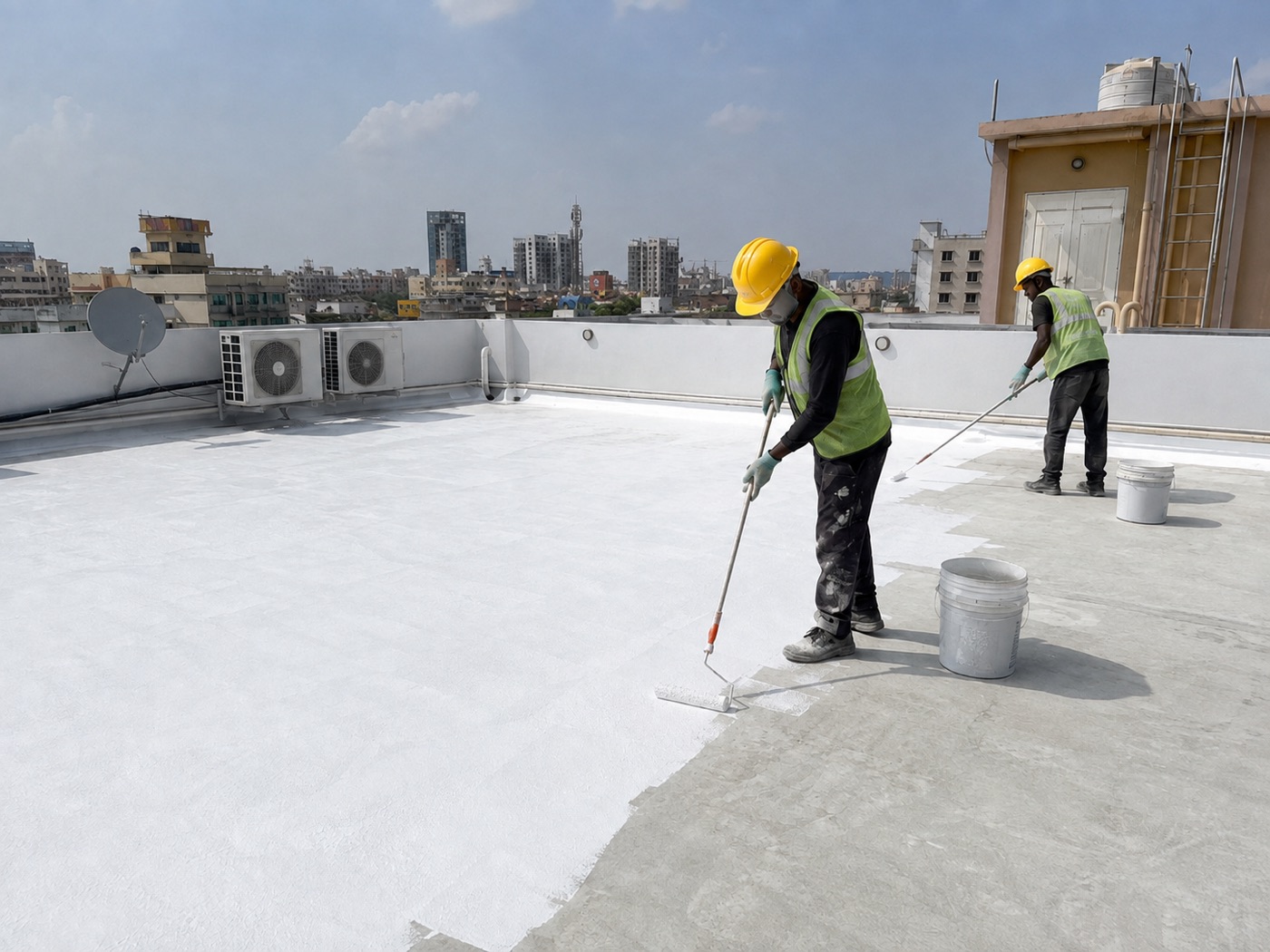
PU Waterproofing for Terraces: Why Elastomeric Beats Rigid Every Time
Ask any building manager in eastern India what fails first and the terrace will be near the top of the list. Ask what specifically failed, and the answer is almost never the middle of the slab. It is a crack, a parapet junction, a drain outlet or the point where a pipe passes through.
That pattern tells you what a terrace waterproofing system actually has to do. It is not primarily about resisting water on a flat surface. It is about accommodating movement without opening a path for water.
Why terraces move
A concrete terrace in India is subjected to a daily thermal cycle that few structures anywhere face. A dark roof surface can reach 60 to 70 degrees Celsius in the afternoon and fall to near ambient overnight. Concrete expands and contracts with that cycle, every day, for the life of the building.
Add structural settlement, shrinkage of the screed in the first year, and vibration, and the result is a surface that is constantly working. Any waterproofing layer that cannot move with it will crack — and a cracked waterproofing layer is not waterproofing at all.
Rigid versus elastomeric
Cementitious systems are rigid. Polymer-modified cementitious coatings bond superbly to concrete, resist water well, and are excellent below tiles in bathrooms where movement is minimal and the covering protects them. On an exposed terrace taking full thermal cycling, a rigid system will eventually crack at the points of highest movement.
Elastomeric polyurethane systems are designed to stretch. A quality PU membrane will accommodate substantial elongation before failure and, more importantly, will bridge a crack that opens beneath it rather than transmitting it through the film.
Bituminous membranes have their place, particularly on large flat roofs, but sheet systems introduce laps and joints — and laps are where sheet systems fail. They also perform poorly under sustained UV unless protected.
For an exposed Indian terrace, the elastomeric liquid-applied route makes the most sense: no joints, conformable to every detail, and capable of moving with the structure.
Crack bridging is the specification that matters
This is the property to ask about, and it is measured. EN 1062-7 classifies crack bridging ability, with tests carried out at low temperature where materials are least flexible.
A system quoting high elongation at 25 degrees but nothing at low temperature is telling you only half the story. It is also worth asking about elongation after ageing — many materials become progressively less flexible with UV exposure, so the crack-bridging figure that matters is the one at year five, not year one.
The sequence that actually works
One — find and fix the source. If water is already entering, the terrace membrane may not be the whole problem. Check parapet copings, drain outlets, plumbing penetrations and the junction with adjacent structures.
Two — prepare the surface properly. Remove laitance and loose material. The substrate must be sound, clean and dry. Moisture in the slab under an impermeable membrane produces blisters within a season.
Three — treat the details first. Cracks opened out and filled. Coves formed at every wall junction — a sharp internal angle is where the membrane thins and splits. Reinforcing tape or fabric at all junctions, drains and penetrations. This step takes the longest and prevents the most failures.
Four — apply the base coat and let it cure properly. Rushing between coats traps solvent and moisture.
Five — apply the membrane to the specified thickness, in the specified number of coats. Terrace waterproofing is one place where dry film thickness is directly proportional to service life, and thinning to stretch material across a larger area is a false economy that shows up in three years.
Six — pond test before handover. Flood the terrace, leave it 48 hours, inspect the ceiling below. Do this before anything is laid over the membrane. After tiling, a failure is a demolition job.
Combining waterproofing with heat reflection
A well-chosen terrace system can do two jobs. A light-coloured, high-reflectance elastomeric topcoat waterproofs and simultaneously lowers the roof surface temperature.
The thermal benefit is real, and there is a second-order benefit that is less obvious: a cooler roof cycles through a narrower temperature range, which means less daily movement, which means less stress on the waterproofing itself. The reflective finish extends the life of the membrane beneath it.
What to ask a supplier
1. Crack bridging classification to EN 1062-7, including the test temperature
2. Elongation after accelerated weathering, not just on a fresh sample
3. Total dry film thickness required, and the number of coats to reach it
4. Detailing requirements at coves, drains and penetrations, in writing
5. Solar reflectance if a reflective finish is part of the system
6. A reference terrace you can visit that is at least three monsoons old
That last one is worth more than the first five. Any system looks good in year one.
Need Technical Assistance?
Our team can help you select the right coating system for your specific application.