
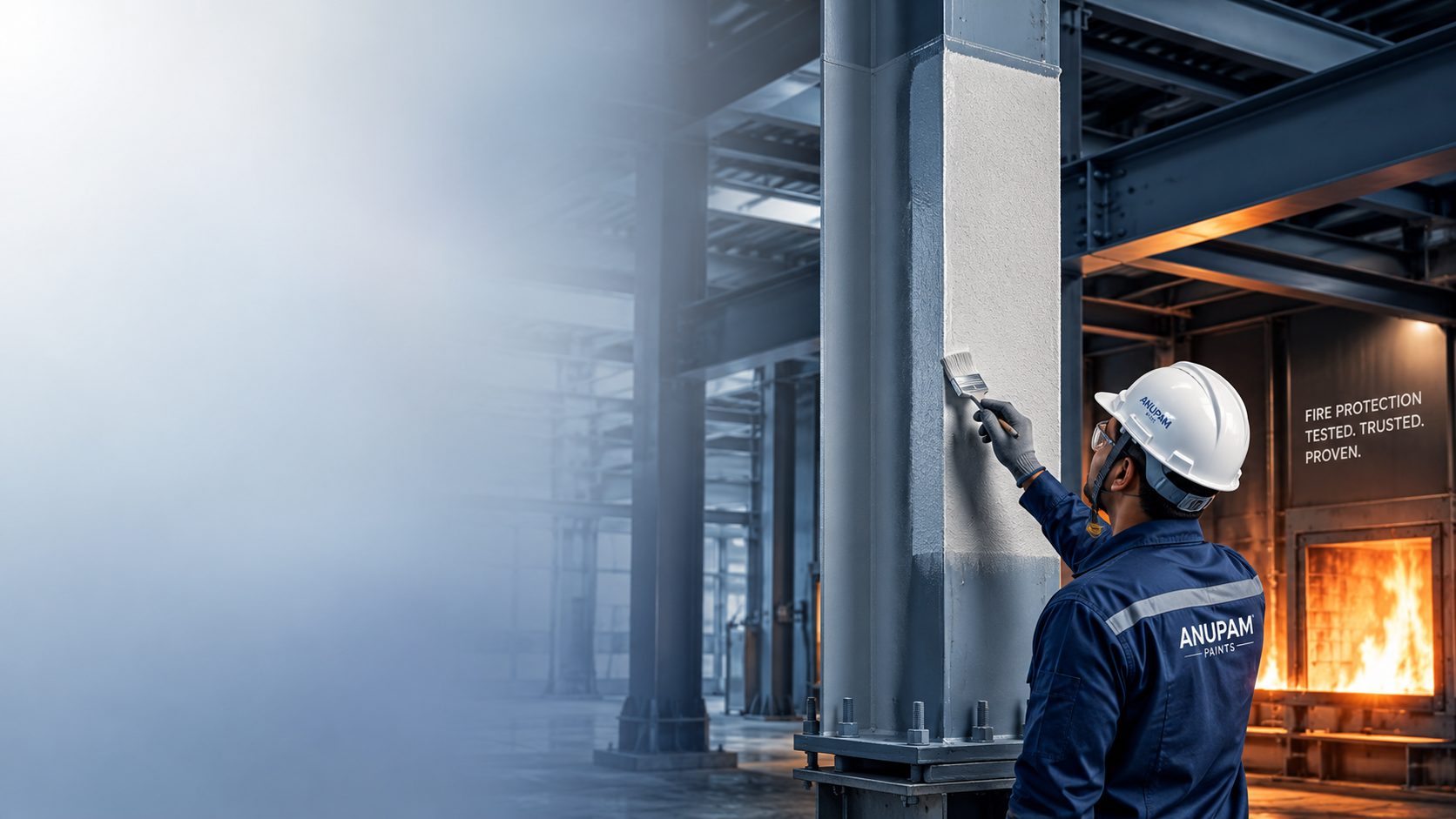
Intumescent Fire Protection: The DFT Is a Calculation, Not a Product Choice
Most coating specifications state a dry film thickness taken from a product data sheet. Intumescent fire protection is the exception, and misunderstanding this is the most consequential error in the field, because the consequence is not premature corrosion. It is structural collapse during a fire.
What intumescent coatings do
Structural steel does not burn, but it loses strength as it heats. By around 550°C, typical structural steel retains roughly half its ambient yield strength — which is broadly the point at which a loaded member can no longer carry its design load. This temperature is referred to as the critical or limiting steel temperature, and the precise figure depends on the member's utilisation.
An intumescent coating looks like paint and behaves like paint until it reaches around 200–250°C. At that point it reacts: the film expands to many times its original thickness, forming a thick insulating char. That char slows heat transfer into the steel, delaying the point at which the member reaches its critical temperature — buying the time needed for occupants to escape and for the fire service to respond.
The rating is expressed in minutes: 30, 60, 90, 120. It is a period of resistance, not a property of the coating alone.
Why the DFT cannot come off a data sheet
The thickness required depends on how quickly the specific steel member heats up, and that varies enormously between members in the same building.
This is captured by the section factor, written Hp/A or A/V — the ratio of the member's heated perimeter to its cross-sectional area. A light, slender section has a large surface area relative to its mass, so it heats rapidly and needs more insulation. A heavy column has a small section factor, heats slowly, and needs less.
The required thickness is therefore a function of four things:
1. The section factor of that specific member
2. The required fire resistance period
3. The critical steel temperature, which follows from the member's structural utilisation
4. Whether the member is exposed on three sides or four
The output is a loading schedule — a member-by-member table of required dry film thickness, derived from fire test data for that specific product, assessed to a standard such as EN 13381-8 or BS 476 Parts 20 and 21.
On a real project, thicknesses across the schedule can vary by a factor of several between the lightest beam and the heaviest column. Applying one uniform thickness across the whole frame means some members are over-coated and wasteful, and others are under-protected and non-compliant.
The common site failures
Applying a single thickness throughout. Faster, simpler, and wrong. Under-protected members do not announce themselves until a fire.
No wet film thickness monitoring during application. Intumescent films are thick and applied in multiple passes. Without wet film checks during application, the dry film is a guess, and rectifying it afterwards is expensive.
Inadequate primer, or the wrong primer. Intumescents must be applied over a compatible primer. A generic shop primer of unknown type is a real risk, and compatibility must be confirmed rather than assumed.
No topcoat where one is required. Many intumescents are water-borne and vulnerable to moisture and UV. Exposed or semi-exposed conditions require a compatible sealer topcoat. Applying an incompatible topcoat can restrict expansion and compromise the entire system.
Damage during construction not repaired. The frame is coated, then services are installed, brackets are welded, and the film is breached. Unrepaired damage is a gap in the protection.
No inspection record. Fire protection is inspected by the authority having jurisdiction and by insurers. Absence of a documented thickness record per member is a compliance problem regardless of what was actually applied.
What a complete specification includes
A proper passive fire protection package is not a line item naming a product. It contains:
The required fire resistance period for each element, from the fire strategy
The critical steel temperature adopted, with justification
Section factors for every member, from the structural engineer
The loading schedule of required DFT per member, from the coating manufacturer against their assessed test data
Primer compatibility confirmation
Topcoat requirement by exposure condition
Inspection and recording procedure, including who signs off
Damage repair procedure
Who does what
This is deliberately a shared responsibility, and gaps appear where the handover is unclear. The fire engineer sets the required periods. The structural engineer supplies section factors and utilisations. The coating manufacturer produces the loading schedule from assessed test evidence. The applicator applies to that schedule and records what was achieved. The inspector verifies.
If any one of those five is missing from a project, the fire protection is not documented, whatever is on the steel.
Ask for the assessment report behind the loading schedule. A product with genuine third-party fire assessment will have one, covering the section factors and periods relevant to the project. It is the single most useful question to ask.
Need Technical Assistance?
Our team can help you select the right coating system for your specific application.